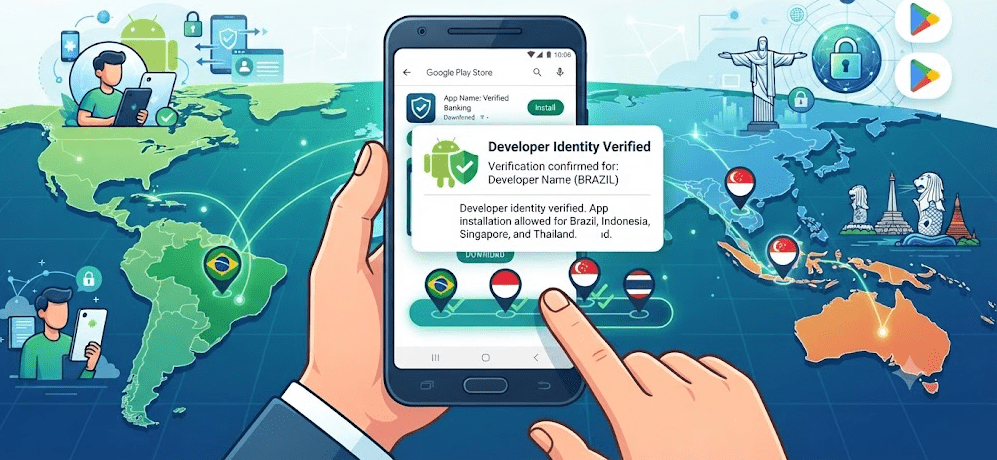

How the Verification System Works
Google has announced that starting September 30, 2026, Android devices in Brazil, Indonesia, Singapore, and Thailand will enforce developer identity verification for app installations. On that date, certified Android phones in these countries will prevent standard installations of apps from unverified developers, regardless of whether the app comes from Google Play or from partner stores run by Samsung, Xiaomi, OPPO, vivo, Honor, and Transsion. Certified devices account for over 95 percent of Android devices outside China.
The enforcement relies on a new system service called the Android Developer Verifier. Being pushed to devices running Android 8 and newer starting in June 2026, this service checks that an app is registered to a verified developer before allowing installation. Apps from unverified developers remain installable through a high friction route that requires the user to enable developer mode, restart the device, wait 24 hours, and reauthenticate. This slower sideloading path will become global in August 2026.
Impact on Developers and Open Source Communities
To register, developers must provide Google with a legal name, address, contact details, and potentially a government ID. They must also prove app ownership by submitting an APK signed with their private key. A standard developer account carries a one time $25 fee. Google is introducing a separate lane for free limited distribution accounts, launching globally in August, which allows students and hobbyists to share apps with up to 20 devices without requiring a government ID or fee.
The open source community has pushed back strongly since the program was announced in August 2025. F-Droid, a free software app repository, says the requirement would end its project because it relies on pseudonymous contributors who will not share legal identities with Google. A campaign called Keep Android Open, backed by over 70 organizations in 23 countries, has asked Google to drop identity checks for apps distributed outside Play. While Google has offered concessions like the advanced sideloading flow and limited distribution accounts, critics argue these do not address the core concern of a single corporation controlling the installation path for nearly all Android devices outside China.
Source: The Hacker News